


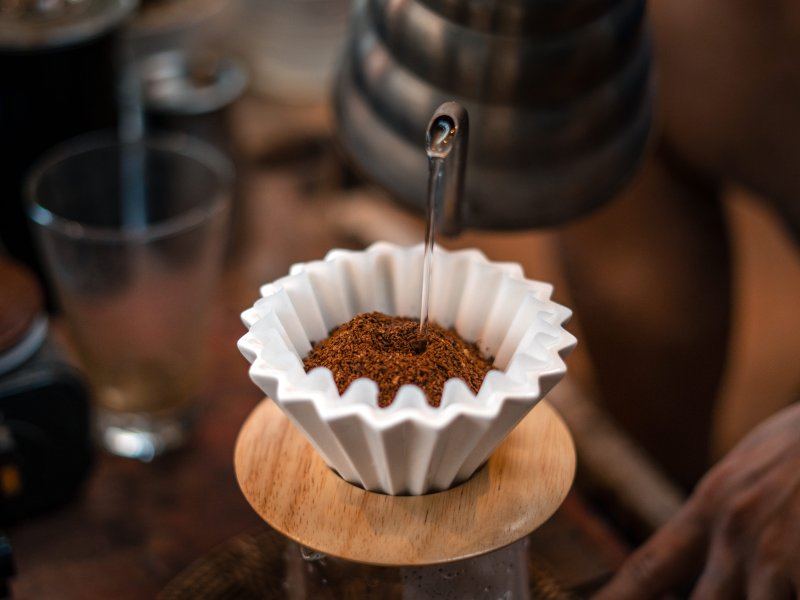
Coffee Extraction
Coffee Extraction: The Myths of Ease and Over-Extraction
Coffee extraction is often surrounded by misconceptions.
Among the most common are two concepts frequently repeated in the market: the idea of "easier extraction" and the constant fear of so-called "over-extraction."
Although popular, these terms often oversimplify processes that are technical, measurable, and generally studied.
What does coffee extraction mean?
Coffee extraction is the physical and chemical process in which soluble compounds from the roasted bean pass into the water.
These compounds include organic acids, sugars, lipids, caffeine, and hundreds of aromatic molecules.
Extraction occurs progressively.
First, acids and volatile compounds are dissolved.
Then, sugars and compounds responsible for body.
Finally, more bitter and astringent compounds appear.
Therefore, extraction is not binary. It happens in well-defined stages, which invalidates simplistic interpretations.
Why the Myth of "Easier Extraction" Arises
The concept of "easier extraction" is often associated with more soluble coffees, darker roasts, or finer grinds.
However, from a technical point of view, no coffee "extracts easily" on its own.
What exists is greater or lesser control of process variables.
-
Among them, the following stand out:
-
Granulometry
-
Water temperature
-
Contact time
-
Pressure
-
Flow rate
-
Roast profile
When these variables are not controlled, extraction becomes unpredictable.
On the other hand, when they are standardized, the process is repeated with precision.
Thus, the term "easy extraction" ends up masking control failures and does not describe a real characteristic of the coffee.
Controlled extraction depends on process
Well-extracted coffees are the result of stable processes. Repeatability is the most important factor for the final quality of the beverage.
This means repeating the same conditions to obtain the same result.
Therefore, correct extraction depends on method, measurement, and consistency.
Understanding the myth of over-extraction
Over-extraction is often associated with bitter or harsh flavors.
However, not all bitterness indicates over-extraction.
From a technical point of view, over-extraction occurs when undesirable compounds are dissolved in excess, usually due to an imbalance of variables.
This can happen due to inadequate grinding, excessive time, or a poorly defined thermal profile.
However, the common mistake is to attribute this result solely to time. The problem is usually in the entire process.
Why control eliminates the fear of over-extraction
When temperature, time, and flow are controlled, extraction remains within a predictable range. According to the Specialty Coffee Association (SCA), the ideal range for most methods is between 18% and 22% extraction.
This range is not achieved by chance. It requires consistency in preparation and, especially, in the prior processing of the bean.
Thus, the fear of over-extraction arises when the process is not technically monitored.
The role of roasting in coffee extraction
Roasting directly influences the solubility of the bean.
During the thermal process, the cellular structure of the coffee transforms, facilitating or hindering extraction.
However, a well-executed roast does not "facilitate" extraction in an uncontrolled way.
It only makes the behavior of the bean more predictable.
Consistent thermal profiles reduce variations and increase sensory stability.
This is widely documented in food engineering and thermal process studies.
Standardized thermal processes reduce errors
When roasting presents internal variations, extraction becomes irregular.
Parts of the bean extract faster, while others are under-extracted.
On the other hand, homogeneous thermal processes promote balance.
This reduces the need for corrective adjustments in preparation.
Therefore, thermal control in roasting has a direct impact on the final extraction.
Connecting Process, Extraction, and Performance
When roasting begins to view the process in an integrated way, extraction ceases to be merely an expected result and becomes a natural consequence of control and precision at each stage.
This concept applies to both specialty and commercial coffee roasting.
In both scenarios, technical mastery of the process ensures consistency and performance over time.
Therefore, many myths related to extraction arise precisely where there is a lack of reliable data, standardization of steps, and equipment designed for control.
Equipment and Control in the Roasting Process
Control of roasting and grinding has a direct influence on extraction.
Equipment developed to offer thermal stability and precision reduces unwanted variations and increases process predictability.
SIATEC Brasil® equipment follows this concept.
They offer more control, standardization, and predictability at every stage of processing, reducing reliance on trial and error and manual adjustments.
Discover SIATEC Brasil® solutions and bring more consistency, performance, and safety to your roasting operation.